
A network operations center (NOC) is a centralized operational function that monitors networks and IT services, investigates alerts, and coordinates responses to availability and performance problems. Its people, processes, and tools help teams detect disruptions and restore affected services. Depending on its scope, a NOC can cover network infrastructure, servers, cloud resources, and applications.
For organizations running cloud platforms or software-as-a-service (SaaS) products, NOC coverage needs to reflect how customers experience the service. Infrastructure can appear healthy while users encounter failed transactions or application errors. Effective operations therefore connect technical signals with service impact and establish who acts when something goes wrong.
What does a NOC do?
A NOC monitors the health of agreed systems and turns relevant alerts into investigation, remediation, or escalation. Its responsibilities should follow the services the business depends on.
Typical areas include:
| Area | What the NOC watches | Operational purpose |
|---|---|---|
| Network availability | Connectivity, device status, and link failures | Identify interrupted access and affected dependencies |
| Network performance | Latency, packet loss, utilization, and interface errors | Investigate degraded connectivity |
| Infrastructure health | Compute resources, storage capacity, and system status | Detect resource constraints and component failures |
| Application health, when included | Errors, response times, databases, and service checks | Identify problems affecting application use |
| Incident coordination | Open incidents, escalation progress, and recovery status | Keep response work moving across teams |
Network monitoring is a core NOC responsibility. Application monitoring, business-indicator tracking, maintenance, and hands-on remediation depend on the operating model and service agreement.
Monitoring coverage and management responsibility are separate decisions. Detecting a database problem does not automatically authorize an operator to change database settings. Each monitored service needs an owner, an escalation path, and a defined set of permitted actions.
How a NOC works
A NOC follows an operational cycle: monitor, triage, investigate, act, verify, and improve.
Monitor and detect
Monitoring systems collect measurements, logs, events, and health-check results. Alerts identify conditions that require attention.
Useful monitoring combines internal system information with evidence of customer-facing behavior. Google’s SRE guidance identifies latency, traffic, errors, and saturation as four important signals for user-facing services. These help teams assess whether systems are delivering their intended service.
Triage and investigate
Operators validate alerts, check maintenance activity, group related events, and assess urgency. Several alerts may come from one underlying problem.
Investigation then examines dependencies, recent changes, logs, and previous incidents. The objective is to establish what is affected and identify a safe next action. Full root-cause analysis may continue after service has been restored.
Remediate and escalate
Operators follow runbooks: documented procedures for investigation and recovery. Depending on their authorization, they may restart a component, execute a recovery workflow, or take another approved action.
When the issue exceeds their access or expertise, they escalate with the findings and actions already taken. AWS identifies clear runbooks and escalation procedures as important NOC practices.
Verify, communicate, and improve
Recovery needs verification against the affected service. An alert clearing is useful evidence, but additional checks may be needed to confirm normal operation.
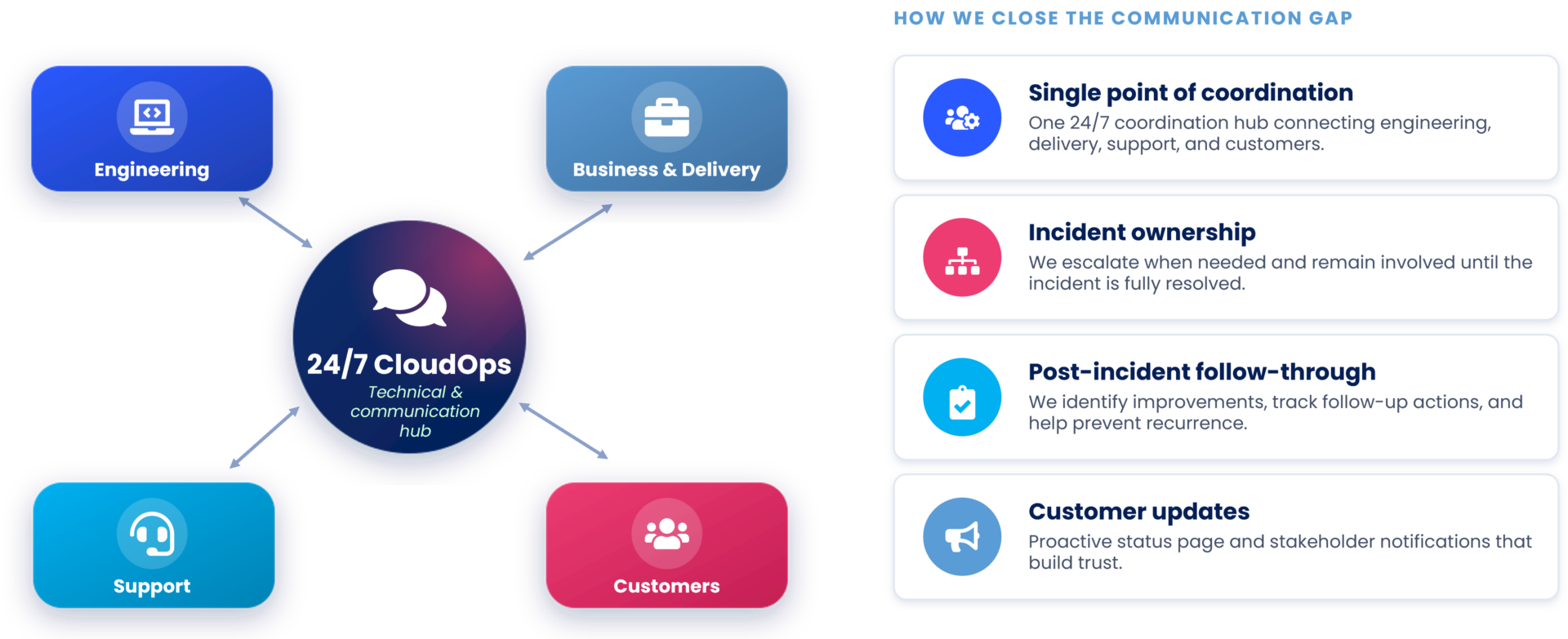
The NOC records the timeline, updates stakeholders, and identifies follow-up work. Google’s incident-management guidance emphasizes clear operational leadership and communication responsibilities during incidents.
Hypothetical example: A SaaS platform shows rising request failures and database connection errors. The NOC groups the alerts, checks recent changes, and follows the approved recovery procedure. If the problem persists, it engages the application engineer with the investigation history. Recovery is verified through application checks and error rates before the incident is closed.
What makes a NOC proactive?
A proactive NOC uses operational evidence to identify developing problems and improve future responses. This can include reviewing capacity trends, investigating recurring alerts, checking service health, and updating procedures after incidents.
For example, steadily increasing storage consumption can justify intervention before capacity is exhausted. Repeated application warnings may warrant investigation even when an individual alert clears automatically.
Proactivity also requires judgment. Suppressing noisy alerts without understanding them can hide important failures. Repeatedly restarting a component may restore service temporarily while leaving the underlying defect unresolved.
The practical test is whether operational findings lead to assigned, completed work. Ask who reviews recurring incidents, maintains runbooks, and follows recommendations through to engineering teams.
The people, processes, and tools involved
A NOC needs operators who understand the environment, clear response procedures, and tools that preserve useful context.
Teams may separate initial triage from advanced investigation and specialist engineering. Labels such as Level 1, Level 2, and Level 3 vary by organization. Support level describes the expertise involved; incident severity describes urgency and business impact.
Essential processes include:
- Service ownership and dependency documentation.
- Severity definitions and escalation rules.
- Approved actions and change permissions.
- Shift handovers and stakeholder communications.
- Incident reviews, training, and runbook updates.
The toolset commonly combines monitoring, logs, alert management, ticketing, paging, operational documentation, and reporting. Integration matters because responders need access to investigation history and recovery guidance.
For example, Datadog documents how its integration with moovingon.ai exchanges alerts, troubleshooting information, and audit records to support investigation and handoffs. This illustrates how monitoring and incident workflows can work together.
NOC vs. SOC vs. help desk
A NOC focuses on operational availability and performance. A security operations center (SOC) focuses on security threats. A help desk supports users with technical issues and requests. IBM defines the SOC’s mission around detecting, analyzing, and responding to security incidents.
| Function | Primary responsibility | Typical example |
|---|---|---|
| NOC | Infrastructure and service availability | Investigate application degradation or connectivity failure |
| SOC | Security monitoring and incident response | Investigate suspicious access and coordinate containment |
| Help desk | User support and service requests | Resolve an access issue or route a reported problem |
These functions overlap. User reports can reveal a wider outage, while unusual traffic may require both operational and security investigation.
Shared tools or staff do not remove the need for clear ownership. During a suspected attack, operational recovery must be coordinated with security responders so actions do not undermine containment or evidence preservation.
In-house, outsourced, and hybrid NOC models
The right model depends on required coverage, internal expertise, workload, and the responsibility your organization can delegate.
| Model | When it can make sense | Main trade-off |
|---|---|---|
| In-house | You need direct control and have sufficient scale and expertise | You own staffing, training, tooling, and coverage continuity |
| Outsourced | You need external operational capacity or extended hours | Results depend on onboarding, environment knowledge, and scope |
| Hybrid | You want external coverage while retaining specialist ownership | Handoffs and shared accountability need careful design |
An internal NOC keeps knowledge close to engineering teams. Its cost includes recruitment, management, leave coverage, and maintaining skills.
Outsourcing can provide response capacity without building every shift internally. Your organization still needs to maintain service ownership, approve access, and handle decisions outside the agreement.
A hybrid model might assign overnight triage and approved recovery work to a provider, while internal engineers retain responsibility for application defects and architectural changes.
How MoovingON’s service fits
MoovingON positions its NOC as a Service around cloud and SaaS production reliability. Its stated coverage includes infrastructure, application components, and business indicators such as usage and revenue.
The service page describes shared, dedicated, and hybrid options, with coverage choices including 24/7 or off-hours and weekends. Shared-service activities include runbook-based triage and remediation; the dedicated offering adds deeper environment specialization and customized communications and reporting. The page also describes working with existing monitoring tools. Monitoring, SRE/DevOps, and managed services are listed as add-ons, so their inclusion should be confirmed in the agreed scope.
Benefits and limitations
A well-run NOC can reduce delays between detection and an organized response. It can also reduce unnecessary engineering interruptions by investigating alerts, handling approved recovery work, and escalating with useful context.
Continuous coverage helps maintain incident ownership across nights, weekends, and shift changes. Reporting can reveal recurring failures and gaps in monitoring or procedures.
These benefits depend on implementation. If every alert is forwarded unchanged, internal workload may remain high. Missing documentation, restricted access, or unclear escalation contacts can delay recovery.
Monitoring alone cannot prevent every outage or guarantee security. Reliability also depends on architecture, tested recovery procedures, capacity, and corrective engineering.
Similarly, a first-response commitment is different from a restoration commitment. Review what the service-level agreement (SLA) measures, when its clock starts, and which dependencies or exclusions apply.
Which NOC KPIs should you track?
Key performance indicators (KPIs) should show both service outcomes and response effectiveness.
| KPI | Definition to agree |
|---|---|
| Service availability | Proportion of the measurement window meeting defined availability criteria |
| Time to detect | Incident onset to detection; identify estimated onset times |
| Time to acknowledge | Alert creation to recorded acceptance by a responsible responder |
| Time to restore | Incident onset to verified service restoration |
| Escalation compliance | Percentage of incidents escalated according to agreed timing and routing |
| Repeat incidents | Recurrence associated with previously identified causes |
Define MTTR explicitly. It can mean mean time to repair, recover, restore, resolve, or respond. Atlassian documents several distinct uses, making the abbreviation insufficient on its own.
For example, define mean time to restore as total elapsed time from incident onset to verified restoration, divided by the number of included incidents. Track permanent corrective work separately.
Review metrics by service and severity. Averages can hide prolonged incidents, and rapid acknowledgement does not necessarily mean rapid recovery. Set targets around business requirements and operational dependencies.
NOCs in cloud and hybrid environments
A cloud or hybrid NOC needs visibility across the services, infrastructure, and connections supporting production.
Cloud platforms retain some responsibilities while customers retain others. AWS’s shared responsibility model, for example, assigns customers responsibility for guest operating systems and applications on Amazon EC2; the division changes with the service used.
Map those responsibilities alongside the NOC’s remit.
There is also overlap with site reliability engineering (SRE) and DevOps, the practices connecting development and operations. SRE applies software engineering to operational reliability. A NOC can provide continuous detection and response while engineering teams improve automation, instrumentation, and underlying systems.
Avoid creating a handoff where incidents repeatedly return without corrective work. Assign ownership for recurring failures, alert tuning, and recovery automation.
When should you consider NOC services?
Consider NOC services when production operates beyond staffed hours, alerts go unattended, engineering teams face frequent operational interruptions, or incidents stall between teams.
Before selecting a provider, ask:
- What is covered? Include infrastructure, applications, dependencies, and any business indicators.
- Who responds after hours? Separate staffed triage, remediation, and specialist availability.
- What can operators change? Establish permissions and approval requirements.
- How do they investigate unfamiliar problems? Ask how findings reach the appropriate specialist.
- How are runbooks maintained? Confirm responsibility for updates after releases and incidents.
- What does the SLA measure? Distinguish response, escalation, and restoration.
- How is onboarding validated? Review monitoring checks, access, communications, and recovery procedures.
Walk through a recent incident with the provider. It is a useful way to test whether the proposed service closes your actual coverage gaps.
Frequently asked questions
Does MoovingON’s NOC monitor applications as well as infrastructure?
Yes. MoovingON’s monitoring scope covers infrastructure, including public cloud, private cloud, and on-premises resources; application components, including frontend, backend, and databases; and business indicators such as real-time usage and revenue. The specific checks and response procedures are agreed for your environment.
Does MoovingON offer only 24/7 coverage?
No. MoovingON offers full 24/7 coverage or off-hours and weekend support. Shared, dedicated, and hybrid service models allow coverage to fit your operational requirements.
Does MoovingON’s NOC replace internal DevOps or SRE teams?
MoovingON’s NOC works alongside your engineering teams, handling alert triage, investigation, and remediation within the agreed scope. SRE/DevOps and managed services are available as additional services when broader engineering or operational support is needed.
Can MoovingON work with our existing monitoring tools?
Yes. MoovingON describes its service as technology agnostic and supports existing monitoring environments, including tools such as Grafana, Prometheus, Datadog, and New Relic. Onboarding establishes how alerts, operational procedures, and communications connect with your existing workflows.
Does MoovingON’s NOC service include remediation?
Yes. The shared NOC offering includes alert triage and remediation based on runbooks. The dedicated offering includes extended runbooks, coordinated incident-response sessions, and root-cause analysis where possible. The service agreement defines permitted actions, escalation requirements, and any additional services.
Start by mapping your critical services to coverage hours, response owners, and permitted recovery actions. Then compare that map with MoovingON’s NOC as a Service to identify the operating model and scope your team needs.
Suggested internal links
| Topic | Natural anchor text |
|---|---|
| NOC service offering | NOC as a Service |
| Monitoring scope and implementation | monitoring cloud infrastructure and applications |
| Engineering support for reliability | SRE and DevOps services |